Subsidizing Essential Needs is Essential to this Portland Nonprofit
by Odochi Akwani, Writer and Content Manager
March 12, 2026
Portland nonprofit, suma, continues to help low-income residents save money on essential expenses like transportation.
The whole is greater than the sum of its parts is a phrase often used to inspire teamwork and collectivism. For Portland-based nonprofit, suma, it’s the foundation of their mission. Suma means “sum, total, addition, or combination” in Spanish. suma is a bilingual community-built payment app that helps low-income households save money on essential expenses. They believe technology should benefit frontline communities who may find themselves exploited by the tech industry.
In 2024, suma received a BBSP mini-grant to conduct shared micromobility education and demonstrate how its app integrates with Lime to offer Lime Access in Portland, Oregon. Flash forward to now, suma has continued its partnership with Lime and expanded its transportation subsidy offerings to include BIKETOWN, Portland’s docked bike share system, through a pilot that began in April 2025.
Through the partnership, BIKETOWN offers users free unlocks and $10 of ride credits each month. Suma adds $75 on top of that to make sure it’s free for even the most active users. Instead of 35 cents per minute for rides, which is the payment structure for non suma participants, suma users pay 5 cents per minute.
Elizabeth in Northeast Portland is a full-time bike commuter, using BIKETOWN through suma.
“I don’t own a vehicle, so I use it pretty regularly,” she says. “I work at a hospital in Southwest Portland, so I ride it there. I was previously a student in Southwest Portland, so I’ve used it to get around to work, school, internships, and to get groceries and visit friends, all the things that you might use a vehicle for.”
According to Jacqueline Gormley, suma’s communication driver, most users rely on shared micromobility to go to the grocery store, work, and doctors’ appointments.
“We have one specific user who looks like she takes a bike to and from work every day,” says Gormley. “She is our biggest rider, and I don’t think she’s ever hit her max credit. We just put that big allotment on there to have it be free.”
Gormley shared that suma saw a lot of growth with Lime usage, due to their presence at farmers’ markets and word of mouth.
“This past year, we had crazy growth in Lime usage,” says Gormley. “We had someone who lived in a transitional housing community that accidentally became an advocate for us. He shared how it was free, and signed up so many people through word of mouth in the houseless community.”
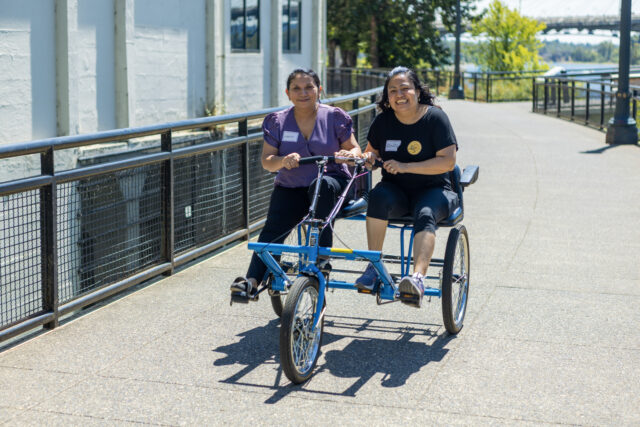
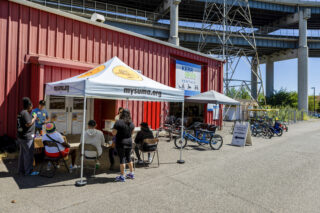
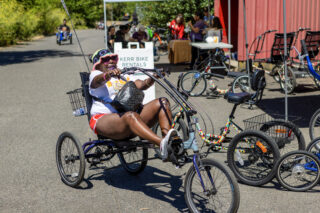
For the partnership with BIKETOWN, suma has hosted several events within the community, including one with Adaptive BIKETOWN, a program in partnership with Albertina Kerr Adaptive. At the event, they introduced participants to Adaptive BIKETOWN bikes and gathered user feedback on their experience, level of interest, preferred ride types, pricing expectations, and accessibility needs. The event served as an initial step in building a relationship between suma and Albertina Kerr to support more inclusive mobility access. All 10 participants at the event were first-time Adaptive BIKETOWN riders who wanted seated shared micromobility options through the suma app.
suma recently hired an ease and accessibility manager to run a focus group with disability community leaders and nonprofits once a month to determine how its app and offerings can be more accessible to everyone by ensuring regular testing and iterating, while creating a framework and guidelines for how to operate.
For a group farmers’ market ride using BIKETOWN, suma partnered with APANO, an Asian advocacy organization, and the Latino Network, a nonprofit that works with Latinx communities across Oregon. This ride introduced community members from East Portland to the suma platform and BIKETOWN bikes, focusing on usability, clarity in the enrollment process, and assessing real-time onboarding and ride flow. Participants took a group ride to Lents International Farmers Market to highlight suma’s Farmers Market Match Program, which offers a $2 market voucher for $1 through suma.
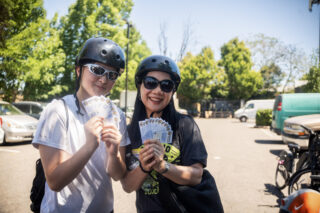
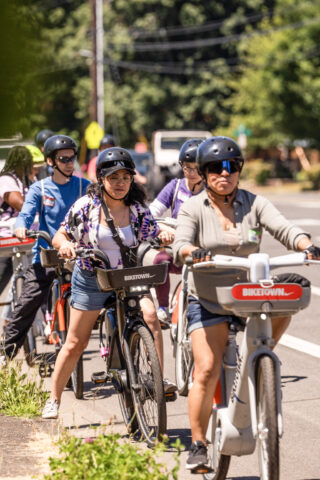
The Portland Bureau of Transportation (PBOT) has supported the work suma is doing for Portland residents. Suma staff received training from PDOT on how to train residents on riding bikes and safety tips, as well as city-provided helmets that suma distributes at events.
Currently, suma is working on getting some payment back into the platform.
“Having money come back into the platform gives us that leverage of ‘Hey, look, we drive traffic to your business, and you could get more ridership through XYZ way if you opened up those options for people,’” says Gormley. “There’s a little bit of payment that will be coming through, but we’re still keeping it more affordable than existing access programs.”
As the weather starts to warm up in Portland, suma is hoping to see an increase in ridership as they expand and revamp the experience for users this year.