
How Vehicle Design Is Increasing Access to Shared Micromobility
by Odochi Akwani, Writer and Content Manager
March 5, 2026
New seated and cargo vehicles from Lime and Veo are shifting ridership patterns, highlighting a need.
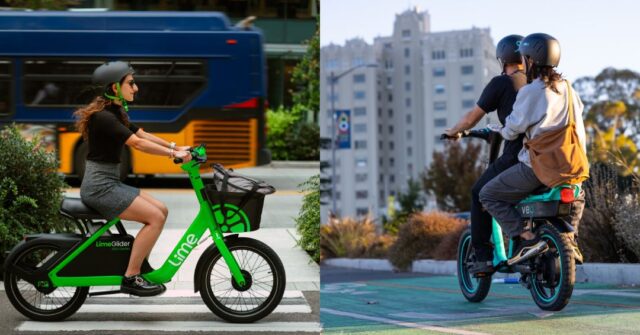
Photos of LimeGlider (left) and Apollo Two-Seater (right) courtesy of Lime and Veo
Not everyone is benefiting from shared micromobility as a transportation option. Caregivers are more likely to trip-chain or need to carry other riders, and regular devices do not accommodate this type of travel. People living with disabilities may be unable to utilize vehicles due to the need to pedal or stand while riding.
“We end up getting the disability community pit against micromobility because of some of the issues that are real and serious,” says Anna Zivarts, executive director and lead organizer of Nondrivers Alliance, a grassroots project dedicated to helping move communities beyond car dependency. “I wish the companies and cities that are regulating them would really step up and address that, because it doesn’t make sense for us to be pitted against each other. There is so much potential benefit for disabled folks and folks who are walking, biking, or rolling places to not have additional cars on the street and have those trips replaced.”
Providers like Lime and Veo are making efforts to increase accessibility through vehicle design. In 2024, global shared micromobility provider Lime rolled out the LimeGlider alongside the LimeBike in Atlanta, Seattle, and Zurich for a pilot. The LimeGlider specifically offers a large, padded seat with a lower center of gravity, footrests instead of pedals, and a top speed of 15mph with slower, more deliberate acceleration. After the success of the pilot, the LimeGlider officially launched in May 2025 and now has fleets in Long Beach, San Francisco, Seattle, Austin, Denver, Los Angeles, Atlanta, and Nashville. In Seattle specifically, Lime saw a 61% increase in its ridership in 2025, which they attribute to the introduction of the LimeGlider, with 2 million trips on the device.
“We launched in May of last year officially, so the LimeGlider hasn’t even been on the streets in the Americas for a full year,” says Julia Stevens, public relations specialist at Lime. “I think the use cases will continue to expand, and we’re just excited about the momentum so far.”
Not only are more people riding these sit-down devices, but they are riding more consistently and for longer. According to Hayden Harvey, head of government relations at Lime, LimeGlider rides aren’t substantially longer, but in aggregate, they are longer than a standing scooter ride. Additionally, when weighted for fleet size between different devices, there’s a strong customer preference for seated options, particularly with the LimeGlider.
“What we also see is folks coming back a second and a third time. I think that’s really important for us,” says Harvey. “LimeGlider has cargo capacity. People are taking longer trips. They’re using it for different things, rather than just point-to-point. I see people with Trader Joe’s grocery bags in the glider basket, and I see people carrying their work briefcases. People are incorporating the glider into the business of their daily lives, rather than just getting to and from a location.”
For Tom W. of San Francisco, the LimeGlider is his preferred option among the city’s dockless shared micromobility options.
“You can sit down as you would in a normal bike, but it also does the movement for you. You don’t have to manually pedal, as you do on a scooter. In terms of comfort and convenience, it’s the best one of the three,” he says.
Veo, a North American shared mobility provider, has incorporated seated devices since 2020 with the industry’s first custom-designed seated e-scooter, the Cosmos. According to Paige Miller, senior manager of policy and communications at Veo, 70% of Veo’s ridership consists of seated vehicles. In their 2025 Rider Survey of 16,000+ respondents (releasing in the coming weeks), 24% of Veo riders reported having a disability.
Last year, at the annual National Association of City Transportation Officials (NACTO) Designing Cities Conference in Washington, D.C., Veo launched its Apollo Cargo in D.C. and Columbus, and later in Los Angeles. In Los Angeles, it is Veo’s most popular vehicle type, with rides typically lasting one mile longer on seated than on standing scooters, according to data from Veo. The Apollo has a 750-watt throttle-assist motor, a top speed of 15 mph, and a 400-pound carrying capacity.
“It [the Apollo] serves as both a two-seater and a cargo vehicle,” says Miller. “We can manufacture one vehicle type, and then we can bring it to a city and deploy all cargo, deploy half cargo, have all two-seaters, or just adjust over time. It’s inherently sustainable because it’s two vehicles in one and serves two purposes.”
Shared micromobility devices with more comfortable features open up this transportation option to more users. Research from the Motability Foundation found that 53% of respondents believe that shared micromobility could improve the lives of people with disabilities because it enables outdoor access, provides a sustainable way to travel, and offers a means to travel spontaneously.
“I talked to folks at Disability Rights Washington and our friends in the accessibility community,” says Harvey. “They’ve embraced the LimeGlider in a big way because there are people living with invisible disabilities who find walking up and down Seattle’s hills hard. The glider avails itself to someone who, pedaling up a big, steep hill, is a barrier for them. It gives those people accessibility to get to the bus or train, not to have to call a car, or wait on paratransit, or wait for their friends and family.”
Veo has been responsive to the needs of its riders through focus groups and rider surveys. Last year, Veo released its “Shared Micromobility For All” Report, which details recommendations for how cities can make their shared micromobility offerings more accessible to all members of their communities, including those living with a disability. Data from their 2024 Rider Survey indicates that users are most interested in the Apollo two-seater due to the ability to carry two riders. 59% say they would transport an adult friend or family member who is unable to operate a scooter or bike themselves, but can ride as a passenger.
“We truly believe the future of micromobility is a mixed fleet,” says Miller. “Our tagline is something for everyone, so we just want to give people options. We’ve asked people in our surveys specifically, if the vehicle type that you prefer isn’t available, what’s your next step? They often [53%] say, they’re going to try a different mode of transportation to get around, so we know that people really have that preference, and we want to be able to meet that.”
For a rider who lives in Brooklyn, a visit to Santa Monica gave her the chance to finally ride with her wife in the Apollo two-seater, since a hip replacement a decade ago left her less confident about stepping onto a bike. She shared the following message on Instagram with Veo.
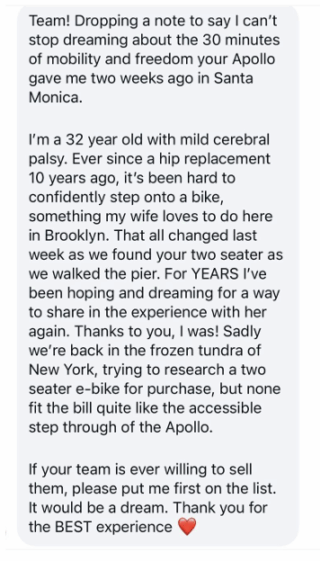
Photo courtesy of Veo
There’s untapped potential for shared micromobility to welcome new riders. Existing mixed fleets with accessible options demonstrate that people within the disabled community can also benefit from shared micromobility. How can providers continue to respond to the needs of their riders?