North Omaha Trail Connects Communities and Centers Its Culture
by Odochi Akwani, Writer and Content Manager
February 12, 2026
A collaborative trail project in the Heartland paves the way toward multimodal transportation and greater public health infrastructure.
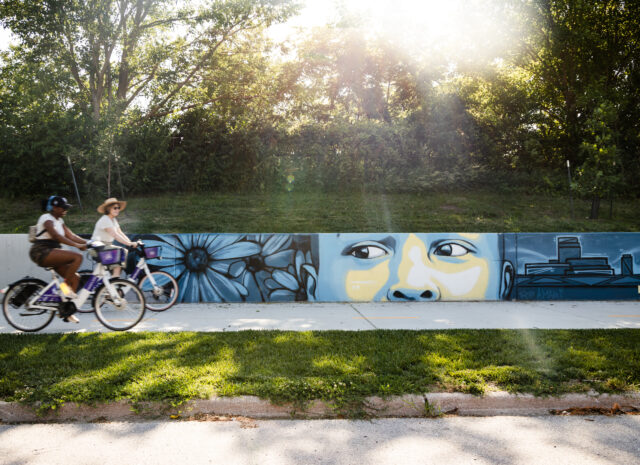
Photo courtesy of Brooklyn Noell
North Omaha is the heart of Omaha, Nebraska’s Black community. It’s home to artists and activists and rich in culture and history. North Omaha is the birthplace of Malcolm X, home to three-weight world champion Terence “Bud” Crawford, and where jazz icons like Duke Ellington performed in the historic Dreamland Ballroom.
Like countless Black communities across the country, North Omaha has experienced generations of disinvestment, including being deliberately cut off from the rest of the city and denied basic public infrastructure and other services. Positively, residents in North Omaha are making strides toward a more connected and healthy neighborhood with projects like The North Omaha Trail, which aims to reconnect the neighborhood and increase public health infrastructure, guided by the communities along the route.
I became interested in sharing this as an Omaha native. Although I grew up in West Omaha, I had the opportunity to bike on the trail in 2022 during the Juneteenth Joy Ride as part of the annual Juneteenth JoyFest, a Black Arts and Cultural Festival founded by Alajia McKizia in 2021.
THE VISION FOR THE NORTH OMAHA TRAIL
Manuel Cook, a North Omaha resident, returned to Omaha after studying in the Netherlands in 2017 and wanted to bike around the city as he had gotten used to overseas. Upon returning, he took a job as a planner for the City of Omaha Planning Department, working with Neighborhood Action and Fact on a North Omaha neighborhood revitalization plan. While searching for different routes to get downtown, he stumbled on the route that is now the North Omaha Trail. He found that other folks in the neighborhood were using it as well to cross the Pratt Street Bridge over Highway 75, which divided and displaced the community in the 80s.
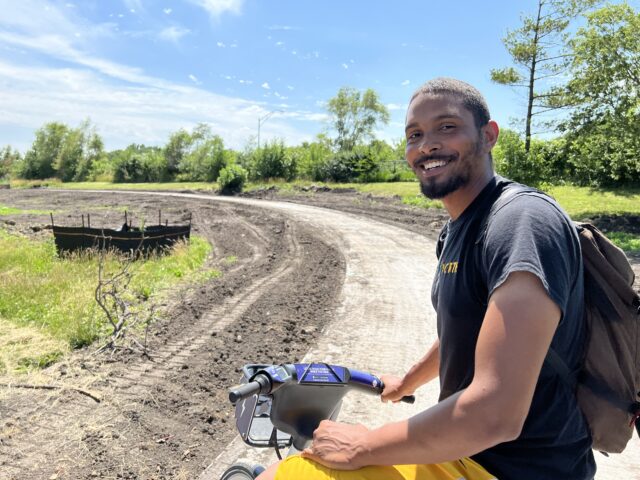
Photo courtesy of Manne Cook
“The idea that came up was having a linear park. That’s how we got some initial funds to clean up the area, and then through that, worked with Papio NRD and the National Park Service to put together the concepts for the North Omaha Trail,” says Cook. “That’s where it really originated, it was that work with the community.”
This set in motion planning and fundraising for the trail in 2018. It was during this same period that Heartland Bike Share, Omaha’s bike share system operated by nonprofit ROAM Share, introduced electric bikes into its system. Cook partnered with Heartland Bike Share to organize a ride, with the first e-bike ride taking place on what would become the North Omaha Trail.
CONNECTION TO BIKE SHARE
Supporters of the trail project have always seen bike share as a natural fit, and the final build-out of the trail project will include Heartland Bike Share stations.
“Often, I learn about a project, and then I force myself in. I have to justify why it makes sense to put bike share,” says Benny Foltz, CEO of ROAM Share, which operates Heartland Bike Share. “But this [project] was very holistic, exciting, and everyone understood. We got no resistance. Bike share was just expected to be on the trail, as bike share should be.”
ROAM Share launched in 2011 with Heartland Bike Share and added Bike LNK in 2018 and Valentine Bike Share in 2020. Equity has always been a priority across the cities they serve in their operations, programming, and community engagement. Heartland Bike Share, specifically, has a Library Pass Program — where bike share passes can be checked out for free at Omaha’s 13 libraries, the Council Bluffs Public Library in Iowa, and the Sump Memorial Library in Papillion. They also offer a Reduced Cost Membership Program across all of their locations, providing $5 annual memberships to financially vulnerable residents, and host a free community rides series called We on Wheels (W.o.W).
In 2024, Foltz worked to introduce the first bike share-specific state bill in the US — LB 1250. The goal of the bill is to create a grant program of up to $250,000 within the Nebraska Department of Economic Development for nonprofit organizations that operate bike share programs. While no action has been taken on the bill yet, it sets an important precedent in the push to ensure dedicated funding for bike share, which is a form of public transportation. The strategies that Foltz has used over the years to gain support for bike share (including taking elected officials on bike rides using bike share) can be added to the list of best practices. In a place that is not particularly bike friendly, where bicycling is often not a priority issue, Foltz has successfully turned unlikely groups of people on to bike share.
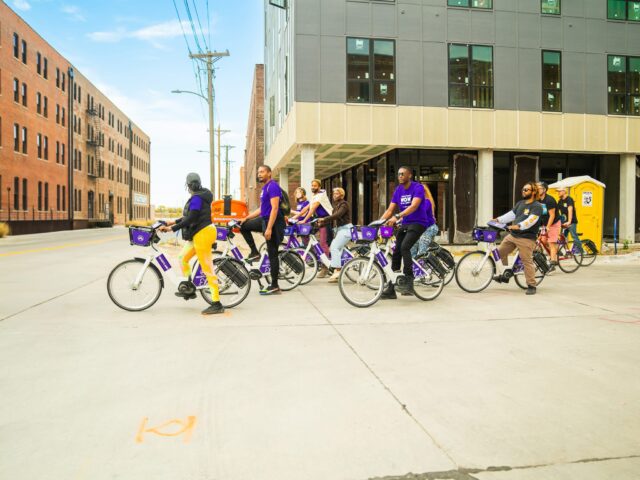
Photo courtesy of Heartland Bike Share
COMMUNITY-LED DESIGN
Eventually, Cook left the city to work at Spark CDI, a nonprofit community development organization in North Omaha, where he continued the trail project. He led community engagement and wrote the North Omaha Trail community design guide. He then led the design team through construction, leading public art and placemaking efforts for Phase 1. Heartland Bike Share was just one of the many partners Spark engaged with. Spark connected with residents and organizations in the neighborhood to design and vote on the trail project logo, and to have their input in the planning of the trail build-out with a community advisory board. Spark receives comments about what’s happening in the community and gathers information about what they know the city is going to do, which they can then communicate to the board. The board, in turn, communicates it back to the community. A separate technical community of experts shares with Spark what they should focus on, review, or consider.
Construction for Phase 1 started in February/March of 2022, with the ribbon cutting on October 22, 2022. Some of the partners during Phase 1 included Keep Omaha Beautiful, who planted trees along the route during the ribbon cutting; artists, including Gerard Pefung, pictured below, on a mural project; and Bike Walk Nebraska, which hosts ride classes. Using data from Strava, a fitness tracking app, Spark was able to gauge trail usage.
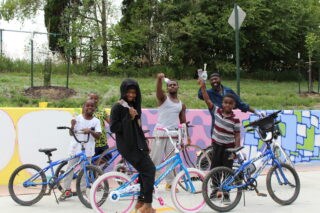
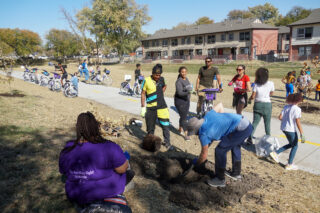
Photos courtesy of Manne Cook and Clarice Dombeck
“From a recreational standpoint, the number of people that were crossing the Pratt Street Bridge before the trail versus after, it was like an 800 or 1,000% increase,” says Ryan ZimmerMas, senior project manager at Spark. “It was something crazy like that. It’s really opened up that bridge to more users. Put it on the map, literally.”
PHASE 2 AND BEYOND
In 2024, Spark was awarded $8 million from the Nebraska Department of Economic Development to begin work on Phase 2 of the trail. Cook believes more commuters will use the trail with the completion of Phase 2, which will include a solid connection all the way into downtown and to Omaha’s RiverFront. In Phase 2, Spark will be able to install the encasement areas for the Heartland Bike Share docks.
Spark was hopeful that Phases 3 and 4, which would have included the installation of seven bike share stations, would be funded through an Environmental Protection Agency Community Change Grant, but a few months after submitting the grant application, the program was essentially nonexistent. Although this particular grant did not work out, Spark formed lasting partnerships as a result of the grant application process. ZimmerMas says the most impactful piece from this experience was getting the buy-in from the city, other institutional partners, and local grassroots partners, which was emphasized in the grant. Partners on the application included Spark Capital, City of Omaha, Keep Omaha Beautiful, Culxr House, Bike Walk Nebraska, Douglas County Health Department, One Omaha, Seventy-Five North Revitalization Corp., and ROAM Share.
FORWARD MOMENTUM CONTINUES
Spark was able to fundraise to complete an initial 10% feasibility study for phases 3 and 4. Now they have a clearer picture of what these future phases will look like and cost, and will continue to fundraise for implementation.
Deisy Cole, current project manager for the North Omaha Trail at Spark, is working with the technical experts to strategize what the trail would look like if Phases 3 and 4 are broken up as smaller amounts of funding become available, and works with those partners to help them identify other funding sources to be able to move their pieces forward as well.
The trail is set to break ground on Phase 2 this April, with expected completion in 2027.
The vision of the North Omaha Trail encapsulates the uniqueness of this Black community in the Midwest — sparking community engagement, multimodal transportation, and environmental justice.
This trail offers an exciting — and visible — opportunity to encourage walking, cycling, and just plain old exercise,” says Omaha Mayor John W. Ewing Jr., a native North Omahan. “More than that, it offers a connection between North Omaha and the City, which should not be mutually exclusive places but instead part of the larger fabric that is One Omaha. I’m so excited to see this trail, and I’m excited to support cyclists and others who will use it.”