Transit Equity Day: A Call For Integrated Transportation Networks
by Odochi Akwani, Writer and Content Manager
February 4, 2026
Today, on February 4, Rosa Parks Transit Equity Day, we honor this civil rights icon and promote public transit as a civil right.
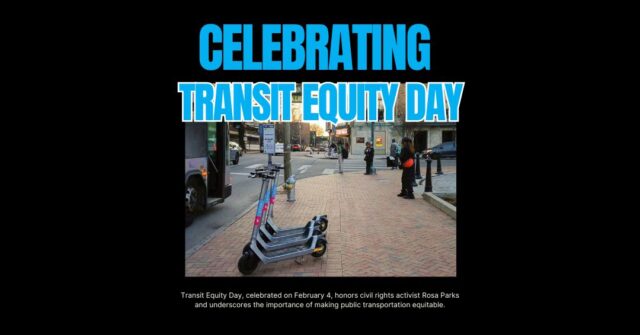
Photo courtesy of The City of Richmond
Transit Equity Day, celebrated on February 4, honors civil rights activist Rosa Parks and underscores the importance of making public transportation equitable. Shared micromobility plays a key role in building equitable transportation systems by offering more mode options, bridging transportation gaps, offering the freedom to rely on oneself, and more. As part of the broader transportation landscape, shared micromobility often complements other fixed route transit services or might be the only mobility option for residents in some communities.
According to The North American Bikeshare and Scootershare Association (NABSA), in 2024, 74% of shared micromobility riders reported that they use shared micromobility to connect to transit, with 22% saying they use it weekly to connect to transit. These stats highlight how critical shared micromobility is for filling transportation gaps via first- and last-mile connections.
Operators like Lyft, Veo, and Lime shared similar findings. Lyft’s 2025 Multimodal Report found that 81% of shared micromobility riders use it to connect to public transit services, with 23% doing so weekly. This number is even higher for riders with household incomes of under $50,000 — 39% use shared micromobility to connect with public transit weekly, compared with 18% for those with a household income of $50,000 or more. Veo’s rider survey, Shifting Gears: How Micromobility Can Move Us Beyond Cars, found that 23% of riders use Veo to connect to transit. At Lime, a report in partnership with The League of American Cyclists found that nearly 1 in 6 riders in Baltimore, Nashville, and Phoenix used Lime to reach transit.
An increasingly common way bike share systems are integrating transit is by having all public transit options in one place. In Tucson, all buses, the streetcar, and TUGO Bike Share can now be accessed directly from the Transit App, which is the new official Suntran Tucson app. Other cities like Milwaukee, Las Vegas, San Antonio, and Pittsburgh have also all fully integrated bike share and transit via the Transit app.
In places like Westchester’s lower Hudson River Valley and Sonoma and Marin Counties in California, bike share is being integrated into regional rail corridors.
“To date, 59% of total rides have started or ended at hubs located at transit stops. The majority of these (57% of total rides) have been connections to and from our regional train (SMART Train), with about 2% connecting to and from local bus stops,” says Marc Azevedo, operations manager for Redwood Bikeshare.
Transit Equity Day is about reinforcing the fact that equitable transportation should be a priority. Communities are stronger when everyone has access to a variety of reliable transportation options.
To learn about how your system can better integrate with transit, check out Integrating Bike Share and Transit from the Transportation Research and Education Center (TREC) at Portland State University.
___________________________________________________________________________________________
The Better Bike Share Partnership is funded by Freedom Together Foundation as a collaboration between the City of Philadelphia, the National Association of City Transportation Officials (NACTO), and the PeopleForBikes Foundation to build equitable and replicable bike share systems. Follow us on LinkedIn, Facebook, Twitter, and Instagram, or sign up for our weekly newsletter.
Have a question or a story idea? Email odochi@peopleforbikes.org.