A Look at Shared Micromobility in the Winter
by Odochi Akwani, Writer and Content Manager
December 11, 2025
How three systems in the Mountain West and Midwest continue to operate in the winter months, including their challenges and findings.
GREENbike in Salt Lake City and Ogden
As parts of North America enter the coldest months of the year, many shared micromobility systems will close due to a combination of low ridership, financial unviability, and device wear and tear. Still, some systems continue offering a year-round service to meet the demand of those who rely on shared micromobility for daily transportation needs. We spoke with three shared micromobility programs in Minneapolis, Des Moines, and Salt Lake City to share their experiences operating throughout the winter.
MINNEAPOLIS
In Minneapolis, the city contracts with Lime and Spin to operate bikes and scooters. Typically, shared micromobility has been seasonal, but last year, a pilot with Lime allowed scooters to operate until the permit expired on December 31.
“We expected about .5 to .75 trips per vehicle per day on that 300 scooter fleet, but we saw about 1.2 to 1.3, so that was pretty encouraging on a smaller fleet,” says Max Gonzalez, project manager for the City of Minneapolis. “We still required them to deploy in our equity areas and not concentrate all the vehicles downtown. With that slightly less dense fleet, it was surprising that we still saw that demand.”
This year, Lime will continue operations through the winter months with 1,000 to 1,500 scooters and approximately 1,000 bikes across Minneapolis and the surrounding region, working with the city of Saint Paul as well as the University of Minnesota.
“One of the big things that we heard is that the transit options after 11 o’clock/midnight really dwindle. Having additional options was the direct feedback we received,” says Gonzalez. “This is one of the opportunities to address some of the lack of transportation access. It was interesting to see that even when it gets as cold and as snowy as it does in Minnesota, there’s still that dedicated ridership base.”
This growing ridership base aligns with the city’s mode-shift goals through its As You Go MPLS initiative, which aims to have 60% of trips in Minneapolis taken by walking, biking, or transit by 2030.
“It’s an opportunity to promote that bike share and scooter share isn’t just a seasonal thing, it’s year-round,” says Gonzalez. “The infrastructure we have gets plowed. Some of the feedback that we get is that the bike lanes are actually plowed better than the streets, which was part of the thinking for the extension of winter operations.”
Minneapolis is hoping to work with other surrounding jurisdictions to encourage this year-round operation. Gonzalez notes that some of the feedback they receive is why a nonphysical boundary prevents someone from completing their trip. So, the city is taking a regional approach to implementing similar regulations, pilot programs, and options for residents across all jurisdictions.
DES MOINES
The nonprofit Street Collective operates Des Moines’ bike share system. It’s been year-round since the 2015–2016 winter season. For bike director Tim Hardie, there’s one main reason are why it’s important to offer bike share year-round.
“It is a question of reliability and communication, “ says Hardie. “I think we are justified, because of the weather, to cut off service or limit service. Still, it’s also our responsibility to communicate that, and how you do that is difficult. Residents have the assumption that it’s going to be available.”
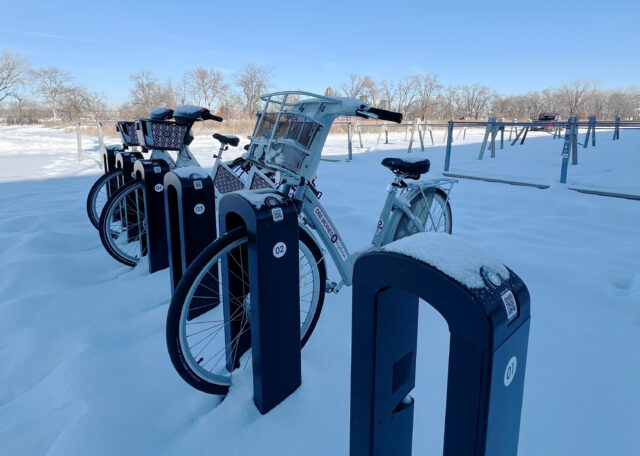
Stations located further away from central downtown are closed, and the fleet of bikes is reduced by 40–50%. According to Hardie, ridership is sparse from mid-December through the beginning of March, with only a handful of rides at most in a few days, primarily from dedicated riders taking short trips, and a few peaks on occasional warmer days.
“If we are saying that we’re providing a transportation option, we should leave an e-bike option out there if we have it, especially in poor weather,” says Hardie. “As a user, appreciate that assistance when I’m not really liking to be out in the weather.”
Des Moines Street Collective
SALT LAKE CITY/OGDEN, UTAH
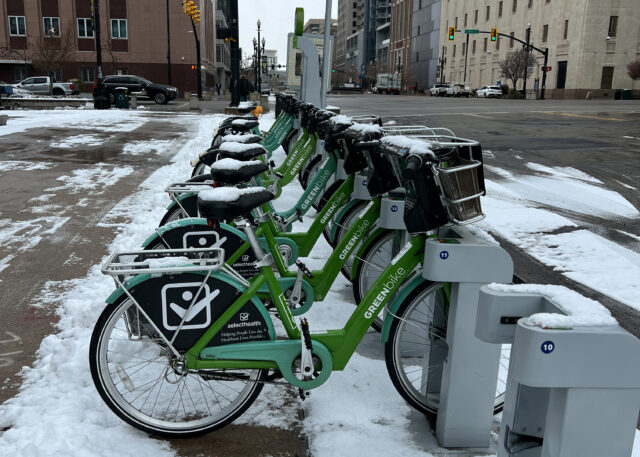
Salt Lake City’s nonprofit bike share system, GREENbike, has been year-round since 2013, and even though they reduce their bike fleet in winter, all stations remain operational all staff stay. Ridership in January 2024 was 35% higher than the previous January, and they’ve seen 30–40% growth in ridership every month this year.
“We like to think of ourselves as a true transportation alternative, and we align very well with first and last-mile for our local transit provider,” says Executive Director Stan Penfold. “Thinking about creating a climate where people rely on us to be an alternative to cars and then just suddenly going away for a significant part of the year is a hard position to defend. Once people make that decision that they’re going to use bike share, there are already enough obstacles for keeping people on bikes, and so we don’t want to be one of those obstacles, because suddenly you don’t have access to our service for three or four months out of the year.”
During this slower season, GREENbike uses it as an opportunity to do a thorough safety inspection on its bike equipment. They rotate every single bike through their shop for a full inspection, doing all the annual maintenance that you know may not have been captured during the season.
“We want them to have a good ride, especially if they’re a first-time user,” says Penfold. “We want people to have a good experience in the system, because we know they’ll come back if they do, and I think a lot of that reflects directly on our commitment to keeping our staff around.”
Currently, GREENbike plans to expand to other communities around Salt Lake City that are connected by transit, similar to Ogden, which is already part of their network and connected by the FrontRunner commuter train, serving 15 stations along an 83-mile route.
As shared micromobility continues to grow, and communities become increasingly reliant on it as a transportation option, winter ridership is likely to continue growing, as seen with GREENbike. While challenges exist, we hope to see continued year-round service in more cities.
____________________________________________________________________________
The Better Bike Share Partnership is funded by Freedom Together Foundation as a collaboration between the City of Philadelphia, the National Association of City Transportation Officials (NACTO), and the PeopleForBikes Foundation to build equitable and replicable bike share systems. Follow us on LinkedIn, Facebook, Twitter, and Instagram, or sign up for our weekly newsletter.
Have a question or a story idea? Email odochi@peopleforbikes.org.